
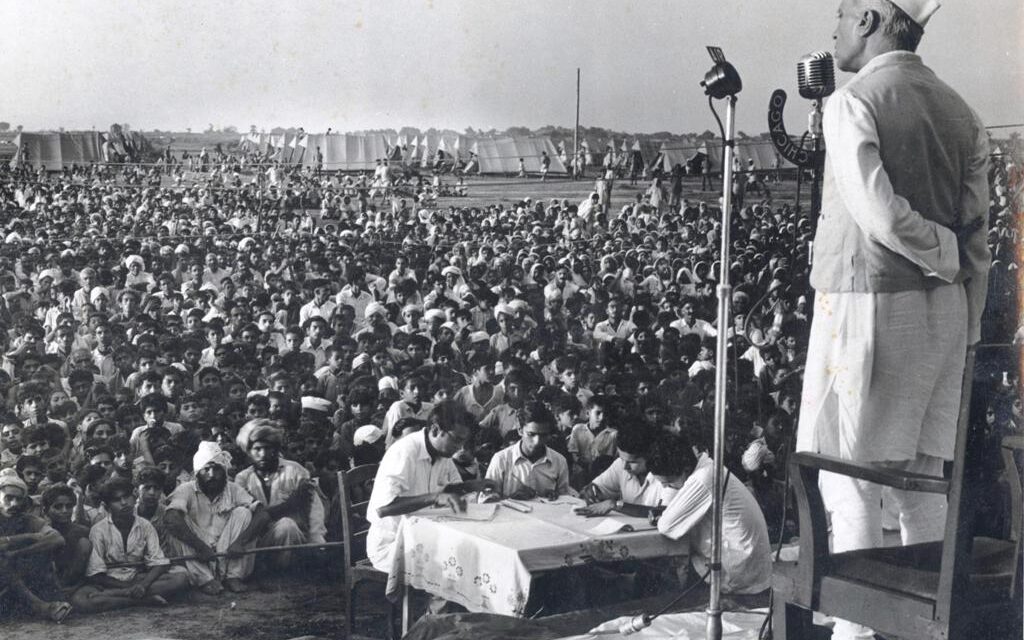
August 10, 1949: Nehru visited the Faridabad refugee camp to outline his vision for a new self-help township and promised to recruit top talent and prevent bureaucratic delays. (Photo Source: / Nehru Memorial Museum & Library / Public Domain)
PREFER TO LISTEN? PRESS PLAY
Conventional wisdom is a cautious creature. Hand a group of seasoned town planners, municipal engineers, architects, and construction managers a barren stretch of earth seventeen miles from Delhi. Saddle them with a shoestring budget and impose a brutal timeline of just about three years to build a city.
Give them a checklist that looks like a logistics nightmare – over 5,000 homes, 20 miles of asphalted roads, 8 large school buildings, health centres, a major hospital, waterworks, complex, underground drainage, a dedicated power station, a cinema, a public building, and a constellation of factories.
Then, drop the ultimate twist: your labourforce consists of 5,000 displaced refugees. Their previous lives were spent behind shop counters, over wholesale ledgers, and in bustling markets. These were people who had never handled a shovel, laid a brick, or broken a stone in their lives. Any seasoned urban planner or project manager would have slammed the folder shut, called it a reckless daydream, and walked away.
What planners dismissed as a suicide mission became a masterclass in logistics, grit, and human perseverance. The birth of Faridabad (1949-1952) reads like an epic movie script, forged by a motley group of dreamers, rebels, and visionaries brought together by destiny to build a city and restore human dignity to the victims of Partition.
At the helm stood the prime minister of a newly independent nation, surrounded by an extraordinary cast: a feisty woman freedom fighter threatening to strike if refugees were not permanently rehabilitated, a Cambridge-educated diplomat swapping high international politics for construction site dust, a Nazi-exiled urban planner pencilling the city layout, a Johns Hopkins-trained doctor building healthcare facilities, and a veteran educator who had just walked the killing fields of Noakhali. Working alongside them was a non-English-speaking German engineer assembling a 6,000 W power plant with Pashto-speaking labourers without manuals or blueprints, a polytechnic instructor designing and fabricating transmission towers on-site, a 24-year-old student forsaking his master’s degree to build labour cooperatives, and a corporate engineer huddling over foundation drawings with ten fresh engineering graduates.
Uniting them all were local villagers who willingly gave up their ancestral lands out of deep compassion and the victims of the traumatic Indo-Pak Partition themselves—refugees who sawed timber, moulded bricks, broke stones, and dug drains to rebuild their lives from scratch.
Faridabad: A Town That Should Never Have Been Needed
Much as we may romanticise Faridabad today as a triumph of human resilience, a sombre truth remains: the necessity for the city should never have existed in the first place, born as it was from the tragic, forced uprooting of an entire generation from their rightful home. This unfortunate need started thousands of kilometres away in the towns of Bannu, Mardan, Kohat, Dera Ismail Khan, Chitral, Amb and Swat in the North West Frontier province, currently known as Khyber Pakhtunkhwa, Pakistan.
For generations, the fortified walled city of Bannu town, which forms the majority representation in Faridabad, was home. Within its gates, a prosperous Hindu and Sikh mercantile community thrived as wealthy merchants owning substantial urban real estate. In the cruel autumn of 1947, the affluence was shattered by the violence of partition, which gripped the land. Their only shield was the Khudai Khidmatgars (the “Servants of God”) led by Khan Abdul Ghaffar Khan, who risked their own lives to protect the Hindu and Sikh population. Without their protection, the vast majority of these families would never have survived to reach India and, ultimately, Faridabad.
Yet, the road to exile held unimaginable horror for many. In January 1948, thousands of refugees from Bannu boarded a train at Peshawar, which was deceitfully diverted to the Gujrat railway station in West Punjab. Stranded in the pitch black, a small, outnumbered contingent of Gorkha soldiers fought heroically to protect the passengers until their ammunition ran dry. The ensuing massacre was a bloodbath that claimed thousands of innocent lives, forever scarring the survivors. Those who lived crossed the border completely destitute, passing through the weeping transit camps located at Kurukshetra and the ancient ruins of Delhi’s Purana Qila.
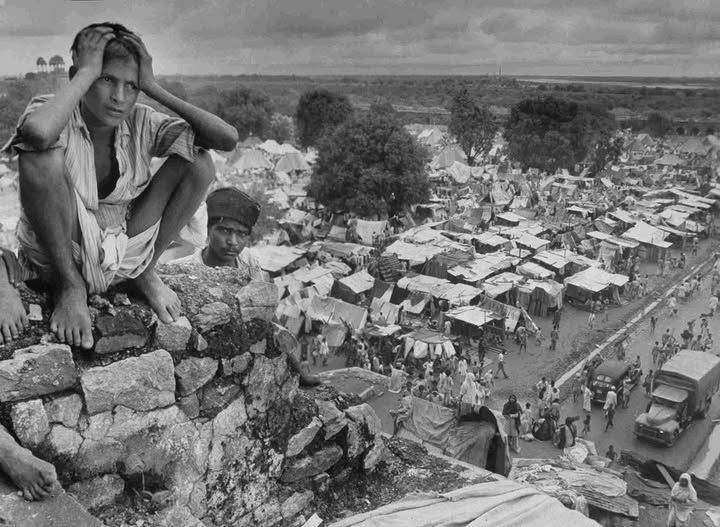
A boy sitting on a rock ledge above a refugee camp at Purana Qila in Delhi during the partition of India, 1947. (Photograph by Margaret Bourke-White/Life Magazine)
Eventually, they were steered toward their final destination: the dusty, barren wilderness of Faridabad. Collectively known as the ‘Bannuwals’ (residents of Bannu), they formed the majority. Living in cramped canvas tents, these former traders would soon use their bare, blistered hands to build an industrial town from scratch.
Years later, to honour their dead during partition riots, the refugees raised the Gurudwara Shahidane Gujrat Train, which still welcomes devotees at its premises at block F, NIT 5, Faridabad. In a profound act of eternal gratitude, they named the town hospital as Badshah Khan (Khan Abdul Ghaffar Khan) Hospital to ensure that the Muslim leader who stood by them in their darkest hour would be remembered forever.
Even today, traces of that lost homeland still echo through the streets of Faridabad. The culture survives dynamically in the unique staging of the Urdu Ramlila penned by Nandlal Batra (a refugee). Meanwhile, culinary staples like aromatic Bannuwali chole and the communal comfort of chicken painda remain cherished threads of an identity from their homeland.
The plight of these refugees could have taken an even darker turn, were it not for the unyielding resolve of one remarkable woman.
The 72-hour deadline
Without Kamaladevi Chattopadhyay (1903-1988), Faridabad was quite literally 72 hours away from never happening at all. In January 1949, Kamaladevi, a stalwart of the Indian Independence movement, walked into the refugee camp at Purana Qila and saw a humanitarian catastrophe waiting to implode. Even after almost two years (1947-49), a vast number of refugees remained unrehabilitated—their dignity reduced to fraying tents, unsanitary conditions, and meagre government doles. At the Jaiselmer House secretariat, the Ministry of Relief and Rehabilitation sat frozen in red tape. They told her to wait for procedures. Kamaladevi refused.
She and her young comrades from the Indian Cooperative Union (ICU) went scouting. Twenty-five miles south of the capital, just across the border into Punjab (now Haryana), they found it. A sprawling expanse of jagged rocks, thorny shrubs, and blistering heat. It was an arid “Crown Waste Land”. To the government, it was a useless wilderness. Yet, when Kamladevi approached the Relief and Rehabilitation Ministry to formally requisition this land for resettling the refugees of Purana Qila, she hit a wall of bureaucratic resistance.
After multiple failed attempts, she marched into the grand corridors of the Secretariat, looked the bureaucrats in the eye, and delivered a shattering three-day ultimatum: “Give us the land in 72 hours, or I will lead tens of thousands of refugees out of Purana Qila myself, and we will occupy the land ourselves.”
It was a staggering gamble. Had she blinked, the refugees would have remained trapped in a bureaucratic runaround. But Kamaladevi had always been feisty and utterly unafraid of authority. During the Salt Satyagraha, she had boldly walked into the Bombay High Court premises, held up a packet of “illegal salt”, and asked the startled magistrate if he would like to buy “the salt of freedom”. As expected, the British arrested her. However, independent India’s response to her 72-hour ultimatum was very different.
The 72-hour threat sent panic through the highest echelons of power. To avoid a catastrophic political disaster on the capital’s doorstep, Prime Minister Jawaharlal Nehru personally intervened, forcing an immediate interstate land transfer from the Punjab government to the Central pool. To cut through any further delay, Nehru ordered the Indian Army to take command of the site immediately. The clock ticked down to the final hours before the midnight clearance documents were signed and rushed by a special messenger to Kamaladevi.
By early 1949, nearly 16,000 refugees left the shadows of Purana Qila and moved immediately into tents at Faridabad (the rest from the Kurukshetra camp subsequently joined). The army had secured the site and provided basic infrastructure. Cooking fires pierced the twilight, tents were claimed, and the first true stirring of life in the wilderness began.
Born out of a fierce 72-hour ultimatum, guided with onsite military precision and raw human determination, the town of Faridabad was officially on its way.
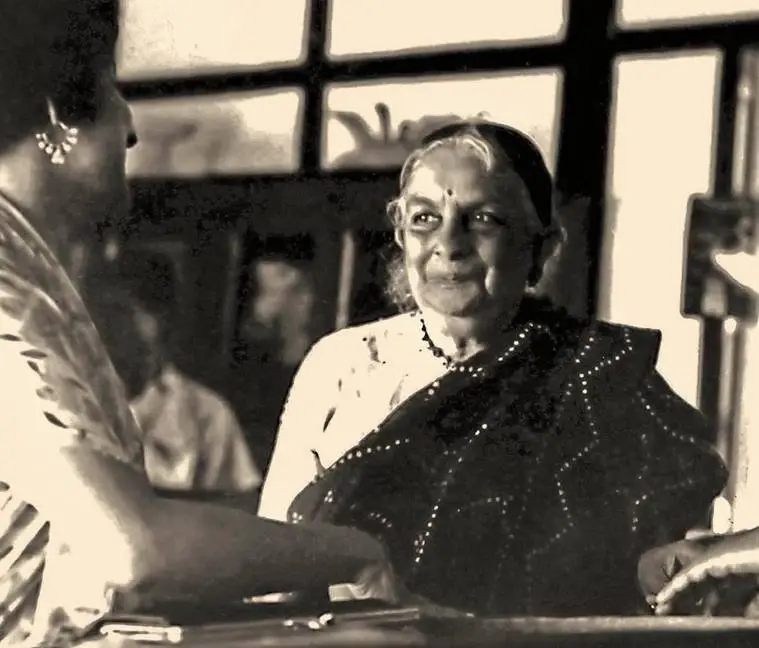
Kamladevi Chattopadhyay, the lady who made Faridabad happen. [Photo Source: Archival photograph from the collection of the Indian Cooperative Union / Crafts Council of India / National Crafts Museum Archives]
The Visionaries at the Helm
While Kamladevi’s grit secured the land, turning a desolate wilderness into a functional city, it demanded an entirely new administrative machinery that could bypass the grinding gears of colonial bureaucracy. In May 1949, the Cabinet approved the creation of the Faridabad Development Board (FDB), India’s first specialised, semi-autonomous body to build a city from scratch.
To lead it, Prime Minister Jawaharlal Nehru handpicked a formidable collective. Leaders like Dr Rajendra Prasad, Sudhir Ghosh, and P.N. Thapar drove administration, while social reformers like Kamaladevi Chattopadhyay, Pt. Hirday Nath Kunzru, and Lady Colleen Nye / B.N. Banerjee spearheaded community building. Master planners Otto Koenigsberger and Albert Mayer, along with Gandhian economist J.C. Kumarappa, guided the city’s economic and physical layout.
Granted rare autonomy to sidestep state red tape, the Board was fiercely guarded by Nehru himself—who personally attended 21 out of 24 board meetings to ensure nothing stalled the new city’s rise.
The New India Speaks Up: The Nissen Hut
The creation of the Faridabad Board reflected a seismic shift as the colonial mindset gave way to the people’s voice in young India. One dramatic showdown on September 5, 1949, perfectly captured this shift.
Prime Minister Jawaharlal Nehru faced a tense showdown with an army delegation led by Brigadier Piggot over the requisition of temporary Nissen huts for Partition refugees
Shaking with indignation, Nehru thundered back: “Army, Army, Army takes its orders from us!”
Beyond shelter, these corrugated steel structures made history when volunteer engineer Gerber Wolfgang reinforced them to house heavy machinery—creating Faridabad’s first polytechnic institute and laying the foundation for its industrial future.
Today, that defining confrontation lives on along Railway Road in NIT-5, opposite the Shree Banke Bihari Mandir, where a locality still proudly bears the name ‘Nissen Hut’—a living testament to the day the new republic asserted its authority.
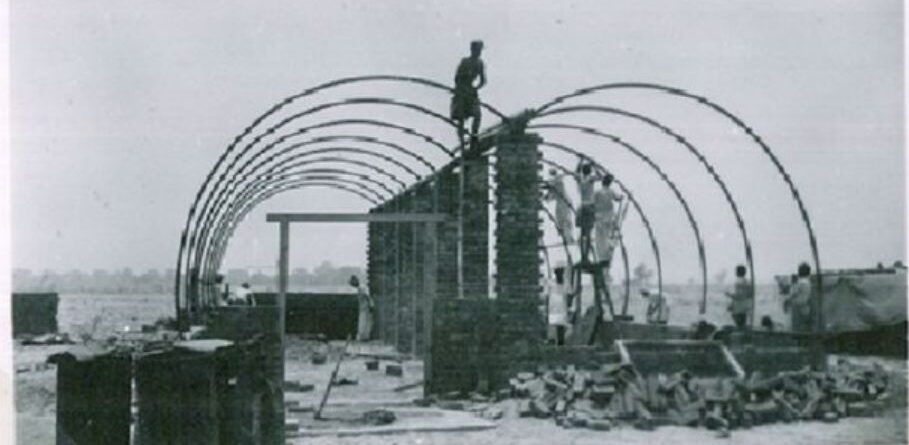
From Battlefield Shelter to Industrial Cradle: Originally designed by American engineer Peter Nissen for World War trenches, corrugated iron Nissen huts became an unlikely lifeline for Partition refugees in Faridabad. Picture source: The Tribune / SCI Archives)
“A Town for the Leisure Class, Built Leisurely”: The PWD Plan Rejected
With the institutional framework of the Faridabad Development Board firmly in place, it was time for action on the ground. But first, the township needed a masterplan.
When the 77-page blueprint for the Faridabad Refugee Township arrived on the desks of the Faridabad Development Board in 1949, it was rooted strictly in classical public works engineering. Prepared by P.L. Verma, Chief Engineer of the East Punjab State, the plan was technically sound, geometrically neat, and structured for an orderly, gradual pace of development. Yet, the board rejected it out of hand.
P.L. Verma was by no means an average town planner; he was a visionary engineer who would later famously assist Le Corbusier in designing Chandigarh, earning a Padma Bhushan for his efforts. But in Faridabad, he had completely misread the human reality on the ground.
Verma’s plan treated the project as a routine engineering exercise, blind to the desperation of 30,000 destitute refugees shivering in canvas tents. His scheme proposed a leisurely five-year timeline carried out by commercial contractors at an astronomical cost of ₹4.64 crore. Crucially, the Board realized that hiring external contractors would generate zero employment for the refugees, leaving them idle, demoralized, and dependent on state doles. Worse still, the plan proposed constructing a meager 500 houses while auctioning the remaining plots to the highest bidder to fund infrastructure—effectively allowing wealthy speculators to price out the very families the township was created to serve.
A Late-Night Call and a New Blueprint for Faridabad
The Board demanded of PWD a radical pivot from its original plan and laid its expectations on the table: build 5,000 houses in half the time, cut costs by 50%, and hand construction directly to the refugees through the Indian Cooperative Union (ICU). But at a high-stakes board meeting, PL Verma, Chief Engineer of the Punjab PWD, countered, insisting that untried refugee labour cooperatives could never match the speed or quality of professional contractors. Cautious under technical advice, the Board caved, fracturing the vision: 2,000 houses were awarded to PWD contractors, leaving a mere 1,000 to the ICU.
The dream of self-reliance was slipping away. The Faridabad innovation of self-built housing was faltering
What followed was a midnight game-changer.
With Prime Minister Nehru set to fly to Colombo at 6:00 AM the next morning, Sarabhai placed an urgent late-night call to his residence. Hearing of the surrender to PWD bureaucracy, Nehru took up his pen. At nearly midnight on January 7, 1950, he fired off a letter to Board Chairman Dr. Rajendra Prasad, arguing that cooperative building was not merely construction—it was human rehabilitation. Blasting the PWD’s “leisurely view of existence,” he reiterated the people-first mandate restored immediately.
That midnight call put the brakes on the PWD approach. The Board limited the role of the PWD and brought in M.J. Bhatt, on secondment from the Delhi Cloth Mills, as the chief engineer
Freed from contractor exploitation, the refugees built all 5,000 houses at breakneck speed. The core construction phase for all 5,000 homes began in early 1950 and was substantially completed by late 1951—shattering the PWD’s sluggish five-year timeline, cutting costs in half, and creating a living testament to human resilience and self-help.
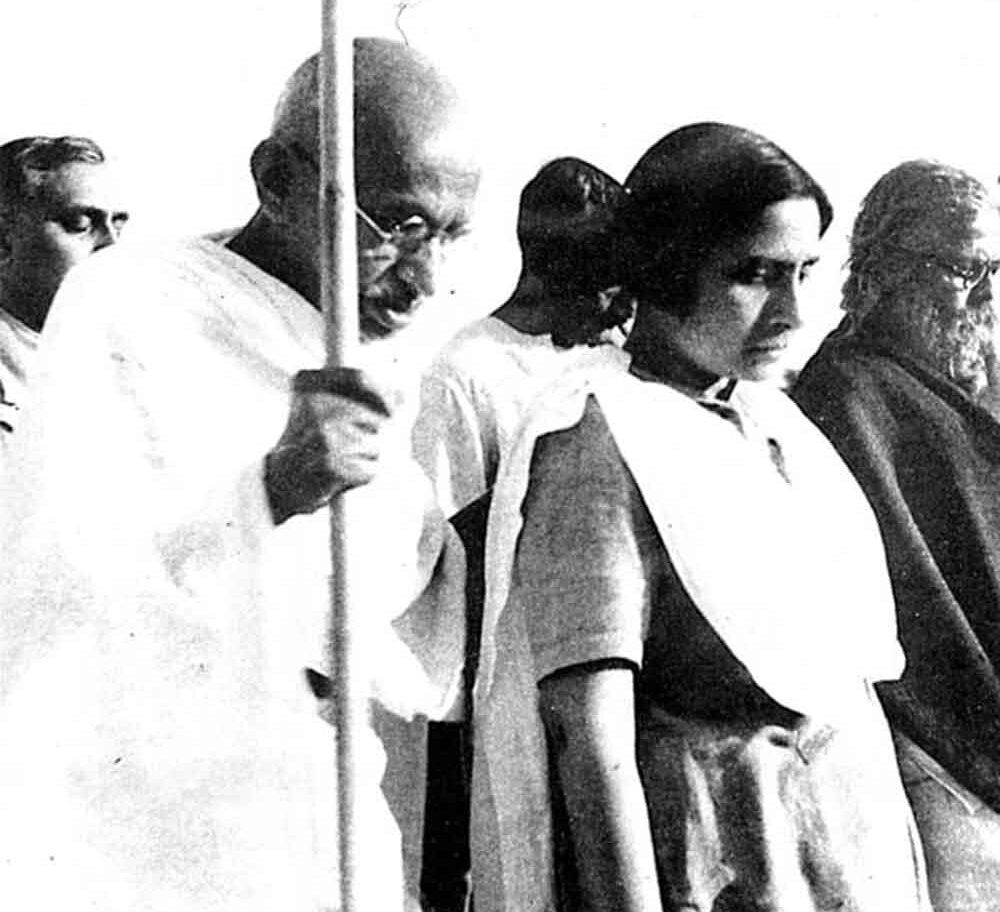
Mridula Sarabhai : Freedom fighter and UCRW leader whose late-night call to Nehru saved Faridabad’s cooperative experiment. [Photo by Jagan Mehta, published in Gandhi in Bihar 1946–47: An Account of Gandhiji’s Peace Mission in Bihar]
Mobilization starts on the ground: leadership in the trenches.
By late 1949, the focus shifted from New Delhi to the dusty plains of Faridabad; men, material, and resources began to pour in. Leading from the trenches was Sudhir Ghosh (1916-1967), a Cambridge-educated diplomat, member secretary of the board, and Faridabad’s first chief administrator. He was ably assisted on the frontlines by his deputy, L.C. Jain from the Indian Cooperative Union (ICU).
While standard bureaucrats issued cold decrees from comfortable offices in Delhi, Sudhir Ghosh did the unthinkable: he packed his bags and moved his entire life into a canvas tent right inside the dusty refugee camp—just a quick drive from the capital, yet a world away in reality. He did not go alone. Beside him was his wife, Dr. Shanti Ghosh—a dedicated doctor whom he had met when both were serving victims of the 1943 Bengal Famine in Calcutta. As one of the very first medical professionals on-site, Dr. Shanti took charge of the camp’s health frontlines. While Sudhir fought structural and bureaucratic battles to raise a city from the dirt, Dr. Shanti fought in the clinic tents against disease, malnutrition, and infant mortality.
Sudhir Ghosh was no ordinary bureaucrat. He had served as Gandhi and Nehru’s key political emissary to London during the 1946 independence negotiations. Ghosh brought a unique blend of administrative rigor and deep Gandhian idealism to his role as Chief Administrator of the Faridabad Development Board.
His decision to move into the refugee camp was a masterstroke of symbolic leadership that fundamentally transformed the project. By enduring harsh tent life alongside 30,000 displaced families, he dissolved their skepticism toward authority and built immediate, unbreakable trust. Shared hardship left zero room for complaint. Seeing their top administrator living in the dust inspired refugees to stop viewing themselves as victims awaiting charity and start acting as proud city-builders.
Above all, it shattered bureaucratic friction. Operating directly from the campsite, Ghosh resolved disputes on the spot, redirected supply chains instantly, and executed in minutes what normally took weeks of government paperwork.
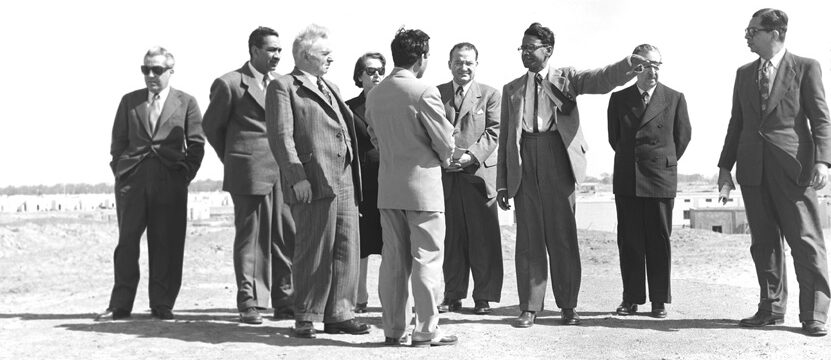
Sudhit Ghosh is seen explaining to members of the Turkish Press Delegation the layout of the Refugee Township of Faridabad (Feb 1952) . In the background, a row of under-construction refugee housing can be seen. [Photo: Photo Division, Government of India]
Getting Down to Brass Tacks: From Tents to Township
The foundation stone for the New Industrial Township (NIT) of Faridabad was officially laid on October 17, 1949. Ending gratuitous government doles and transforming a sprawling tent city of 30,000 traumatized refugees into a thriving, self-sufficient industrial township was a feat many thought impossible. Charity could keep families alive, but only purpose and labor could restore their dignity.
What followed was a remarkable series of unconventional execution strategies and visionary individuals, the true “Pillars of Hope,” that carved modern Faridabad out of the wilderness.
Pillar 1: Talk, Talk, and Talk—Convincing Merchants to Wield the Shovel
The refugees were not builders. They were proud traders, moneylenders, and shopkeepers from the North-West Frontier Province (NWFP)—men whose hands had known ledgers and scales, not pickaxes and mortar. In their eyes, physical labor was a degradation, an intolerable blow to their social dignity. When Sudhir Ghosh proposed that they build their own city, the camp erupted in bitter resistance. They demanded permanent government rations and state-built housing.
Ghosh knew that no administrative order could force a proud community into manual work. As he later recorded in his memoir Gandhi’s Emissary, what followed was weeks of endless, passionate debate—a strategy he called “Talk, Talk, and Talk.”
Standing before thousands of angry refugees in the dusty camp center, Ghosh used no police force or official threats. Instead, he relied on the moral weight of his presence—a man who slept in the same canvas tent and ate the same rations. He challenged their pride directly, warning them that living on state handouts was a form of slow spiritual decay that would strip them of their self-respect. He offered them no charity; he offered them ownership. Slowly, the wall of resistance crumbled. Proud shopkeepers took off their shawls, stepped into the mud, and picked up the shovel.
The psychological shift paid off instantly in economic terms. Official records from the Faridabad Development Board reveal a masterfully organized blueprint: out of a camp population of 18,000, about 3,000 workers were mobilized daily in the very first year of construction. As they earned regular wages, the reliance on handouts quickly began to recede.
They were deployed across every facet of city-building—constructing houses and paving roads, staffing consumer cooperative outlets, firing brick kilns, crafting doors and windows in carpentry workshops, quarrying stone, and planting trees for township nurseries.
By transforming passive victims into the paid architects of their own city, the Board didn’t just build roads and houses—it restored the shattered dignity of a displaced people.
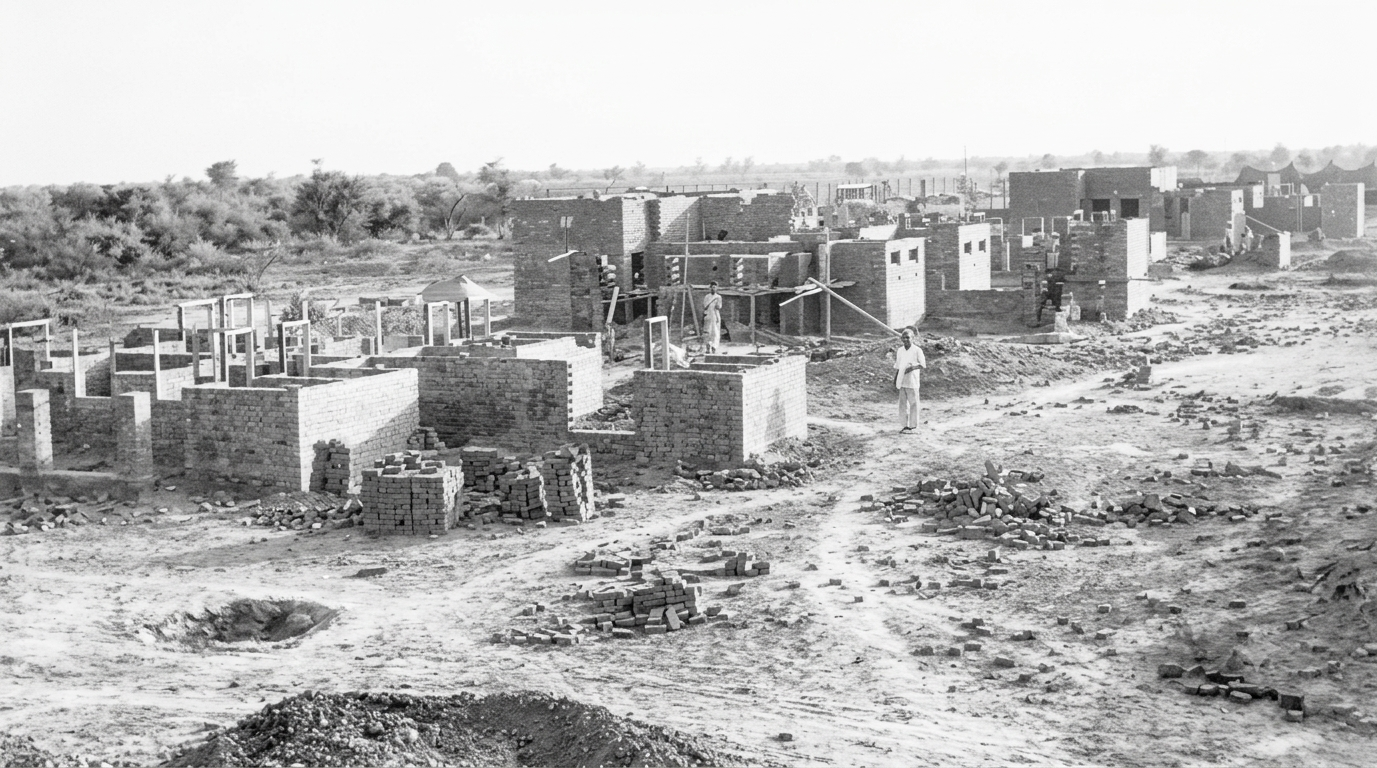
From Tents to Brick and Mortar: Refugee families constructing their own homes in Faridabad. Guided by the self-help blueprint of the Faridabad Development Board and the Indian Cooperative Union, thousands of displaced families earned daily wages while building the very city they would inhabit. [Photo: Photo Division, Government of India / National Archives (Public Domain)]
Pillar 2: for the people, by the people: The Elected Advisory Committee (independent India’s First Adult Suffrage)
Administration at the camp was initially run by military authorities to maintain order. However, popular resentment flared quickly against rigid martial rule. Recognizing that a free people could not be governed by military decrees, Sudhir Ghosh and the Board bypassed bureaucratic hierarchy to establish a democratic Advisory Committee composed entirely of the displaced refugees.
In the first week of October, 1949, the Faridabad Development Board organized a local election based on universal adult franchise. This was a historic, unprecedented moment: every adult refugee (above 21 years of age), man and woman, was granted an equal vote to choose their leaders. This was the first instance of adult suffrage in independent India, a full three years before India’s first national general election in 1952 and months before the formal adoption of the Indian Constitution.
Fourteen representatives were elected, each assigned specific portfolio responsibilities over key camp operations. The refugees chose Salar Sukhram, a legendary Pashto singer turned volunteer leader, as President of the Committee, while Chacha Lakkhi Chand was elected Vice President.
By granting the refugees a democratically backed seat at the planning table, the administration transformed camp governance from military oversight into community self-rule. No longer passive subjects, the refugees debated and approved every street layout, housing grid, and public building plan—ensuring that the city rising from the dust was truly built by the people, for the people.
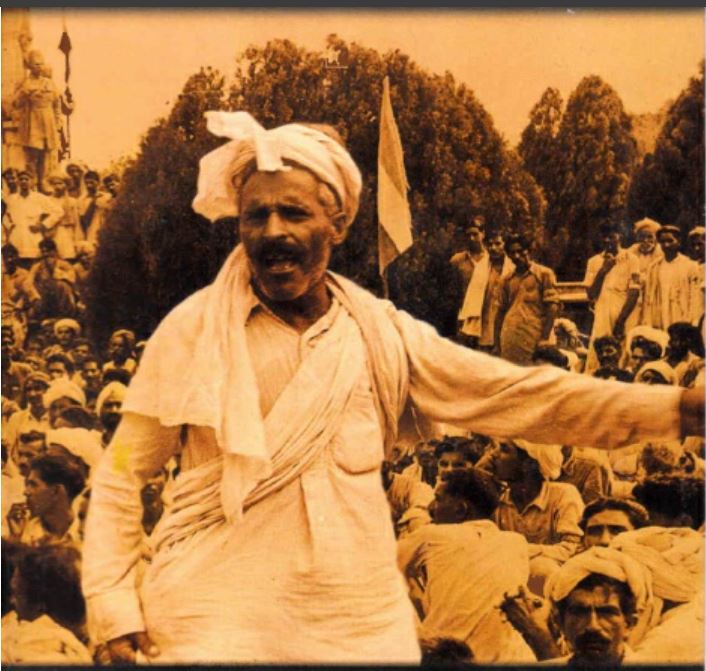
Salar Sukhram, the first president of the advisory committee, was a refugee from Bannu town in NWFP. LC Jain, the deputy of Sudhir Ghosh and ICU representative on the ground, speaks highly of Salar Sukhram, and mentions him to be a very popular leader amongst the refugees. In his book The City of Hope, Jain has put the picture of Salar Sukhram on the cover page, which is reproduced above.
Pillar 3: The “Shaabaash” Blueprint: Engineering with Compassion
While refugees were convinced to build the town with their own hands, raw labor without technical expertise was useless. Yet the Public Works Department (PWD) stubbornly refused to engage them, openly scoffing at the idea of using “untrained” refugees instead of their trusted commercial contractors.
Undeterred, the board bypassed the PWD engineers entirely.
They brought in M.J. Bhatt—an affable, deeply practical civil engineer on loan from Delhi Cloth Mills—and handed him a nimble team of fresh engineering graduates recruited from premier institutes like Roorkee (Thomason College) and Bangalore (Visvesvaraya College of Engineering).
This young team threw out the traditional PWD playbook. Uncorrupted by colonial bureaucratic indifference, they didn’t view the refugees as hired labor to be bossed around. Instead, they treated them as the “house owners” building their own homes, viewing their own role strictly as technical allies. Bhatt established an internal engineering wing that acted as a human buffer, shielding the refugees from external bureaucratic interference while physically working alongside them to mix mortar, align brickwork, and manufacture building components on-site.
Bhatt’s compassionate, common-sense philosophy was best captured during a routine site review. When about 200 houses had been completed, the engineers discovered that nearly two extra bags of cement had been used per house beyond the permitted allocation. An inquiry revealed a silent conspiracy: the refugee builders had used the extra cement to construct small sitting platforms at the entrance of every home, a feature omitted in the official design.
When the inquiry report reached Chief Engineer Bhatt, instead of issuing reprimands, he broke into a smile and exclaimed, “Shaabaash!” (Well done!). His reasoning was beautifully simple: the cement hadn’t been stolen; it had been used to elevate the liveability and genuine value of the homes. “Our error,” Bhatt declared. “We should have provided for the platform ourselves.” From that day on, Bhatt officially updated the engineering blueprints, making the entrance platform a standard feature for every remaining house in Faridabad.
It is deeply unfortunate that no photograph of Engineer Bhatt can be found in public records; the man who helped craft the town, brick by brick, remains entirely forgotten.
Pillar 4: Keeping a city alive as it built itself
As the refugee camp got busy building a city for itself, the health issues were staggering. Construction injuries were constant, waterborne cholera swept through the dense tent colonies, tuberculosis was rampant in crowded tent camps, children and pregnant women suffered from severe malnutrition driven by meager rations and destitution, and a host of opportunistic diseases. In 1950, Dr. Sushila Nayyar (1914-2001), a graduate of Johns Hopkins Medical College, took charge as Chief Medical Officer and established a pioneering healthcare framework for the fledgling township.
Instead of waiting for patients in distant wards, Dr. Nayyar brought care to the doorstep. Faridabad became the first township to open primary dispensaries in every neighborhood, ensuring care was within walking distance. The newly built Badshah Khan (BK) Hospital was reserved as a referral hub, keeping primary care anchored at the grassroots.
Her team set up work-site clinics at brick kilns and stone quarries to treat heavy construction injuries on the spot. Concurrently, she launched India’s first full-population tuberculosis screening program, pairing it with public health film screenings and opening a dedicated TB sanatorium (housed in tents) to isolate severe cases from crowded tent lines.
The sheer scale of this preventive campaign was staggering. By December 1951 alone, Dr. Nayyar’s network of neighborhood dispensaries and field clinics had treated over 2.12 lakh (212,000) cases.
These groundbreaking public health innovations proved so effective that they were later adopted as the gold-standard blueprint for India’s industrial steel townships—including Rourkela, Bhilai, and Durgapur. Ultimately, the core approaches tested at Faridabad’s refugee camps were woven directly into national health policy, a lineage that lives on in India’s National Health Mission of today.
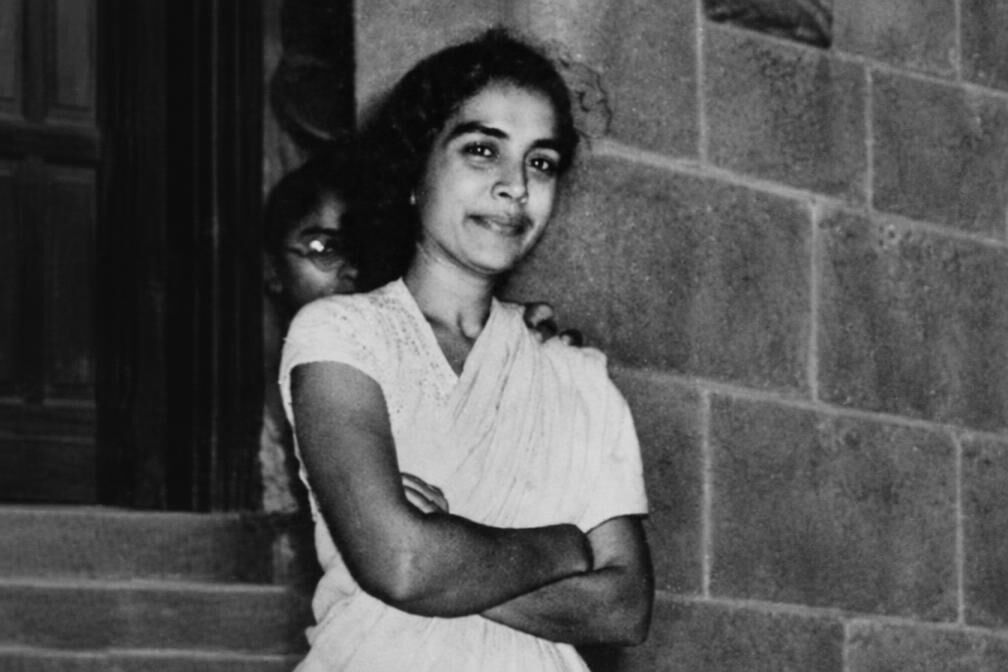
Dr. Sushila Nayyar: Gandhi’s personal physician and Johns Hopkins alumna who built Faridabad’s health network—from tented field clinics to founding Badshah Khan (BK) Hospital.
Behind Faridabad’s health blueprint were a team of doctors who brought Dr Nayyar’s vision to life. The contributions of two women stand out.
Dr. Shanti Ghosh, an alumnus of the London School of Tropical Medicine, led pediatrics at Badshah Khan Hospital. She introduced unheard-of preventive innovations at that time, pioneering child growth tracking, family health cards, and targeted nutrition programs for mothers and infants. Dr. Margaret Mamgain embodied street-level care. Refusing to sit passively in a clinic, she walked every sector, knowing every family and doorstep by name. Her intimate ground presence turned family health folders into living tools of active, compassionate tracking.
Despite its groundbreaking success, the project faced relentless budget cuts from the Ministry of Rehabilitation. While Prime Minister Nehru fiercely defended the model, financial austerity steadily squeezed the vision. In March 1952, Board member Colleen (Lady) Nye issued a stark, heartbreaking warning: budget cuts were forcing diagnosed tuberculosis patients back into crowded single-room homes without isolation, undermining the very preventive model they had fought to build.
Though financial pressures curtailed its full potential, the courage of these doctors endures. Faridabad proved that true public health begins not in crowded hospital corridors, but in the heart of the community.
Pillar 5: Classrooms Under Canvas
By 1949, refugee children had spent two painful years in camps at Purana Qila and Kurukshetra with zero access to schooling. The Board knew this education gap was a ticking clock. But the traditional, textbook-heavy British curriculum was useless for traumatized children who needed immediate survival and life skills.
To bridge the chasm, the Board brought in Asha Devi Aryanayakam (1901-1970), a legendary educator who had spent decades alongside Mahatma Gandhi at Sevagram, pioneering his radical vision of Nai Talim (Basic Education), which blended academic learning with practical craftsmanship. Born in Lahore to a Bengali family, Asha Devi possessed a natural fluency in Punjabi, Urdu, and Hindustani. This deep linguistic bridge allowed her to connect instantly and profoundly with the displaced families, breaking through the barriers of their grief and suspicion. Asha Devi deployed a fast-acting, emergency education model directly in the refugee camps.
Refusing to wait for brick-and-mortar buildings, she set up open-air classrooms and tented learning centers virtually overnight. Her curriculum seamlessly integrated mental and physical labor: children spent half their day mastering science, mathematics, and languages, and the other half learning productive, hands-on trades like spinning, weaving, and carpentry.
To solve the acute teacher shortage, Asha Devi identified literate refugees directly from the camp population and sent them to Sevagram for intensive, accelerated training before deploying them right back to lead classrooms in Faridabad.
Above all, her schools served as sanctuaries for emotional recovery. Learning spilled into the streets as students actively managed camp sanitation, cultivated community vegetable gardens, and staged weekly cultural performances—channeling civic pride to provide vital catharsis for young minds that had witnessed the trauma of Partition.
Launching in August 1949, the initiative expanded by 1952 into eight cottage-style basic schools, a high school, and bustling night classes for adult literacy. Over 4,500 refugee children—including more than 2,000 girls taught by women trained directly from within the camps—were brought into the fold.
While those original canvas classrooms are long gone, their legacy built modern Faridabad. The traumatized children who learned reading, arithmetic, and work ethic under Asha Devi’s roofs grew up to become the engineers, factory owners, and civic leaders who built the city into an industrial powerhouse.
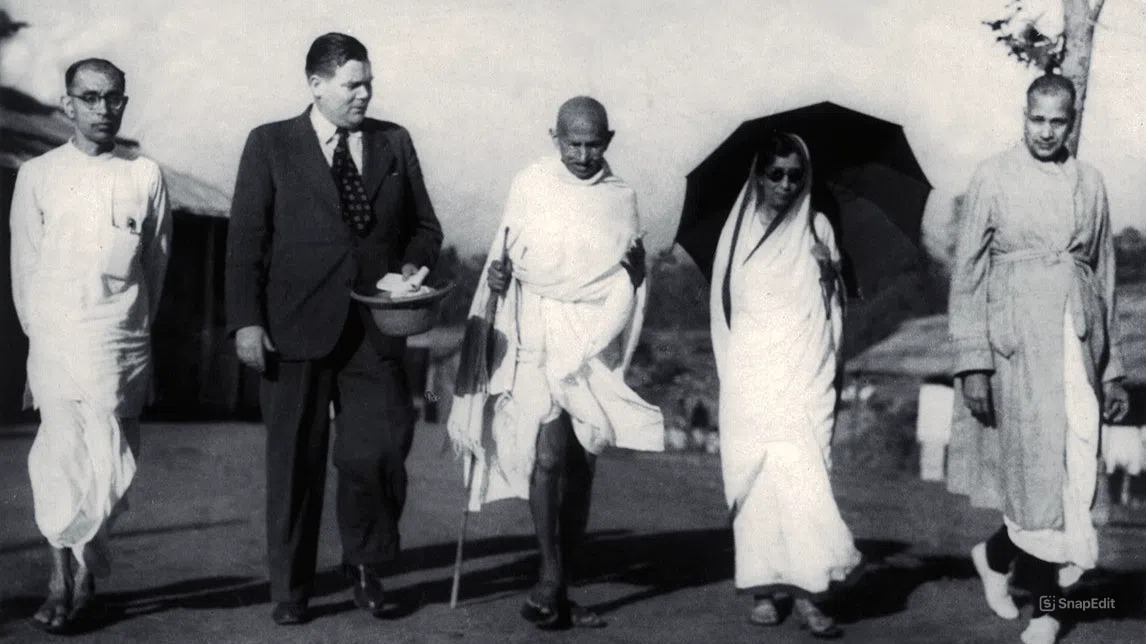
Walking Through the Storm: Asha Devi Aryanayakam (holding umbrella) and her husband, E.W. Aryanayakam (extreme left), walk alongside Mahatma Gandhi through riot-torn East Bengal. A highly educated Bengali scholar invited by Rabindranath Tagore to lead Santiniketan’s women’s wing—where Tagore personally arranged her marriage to his Sri Lankan secretary—Asha Devi would bring this same fearless, ground-level Gandhian spirit to build Faridabad’s emergency Nai Talim schools.
Pillar 6: Cooperatives build a city.
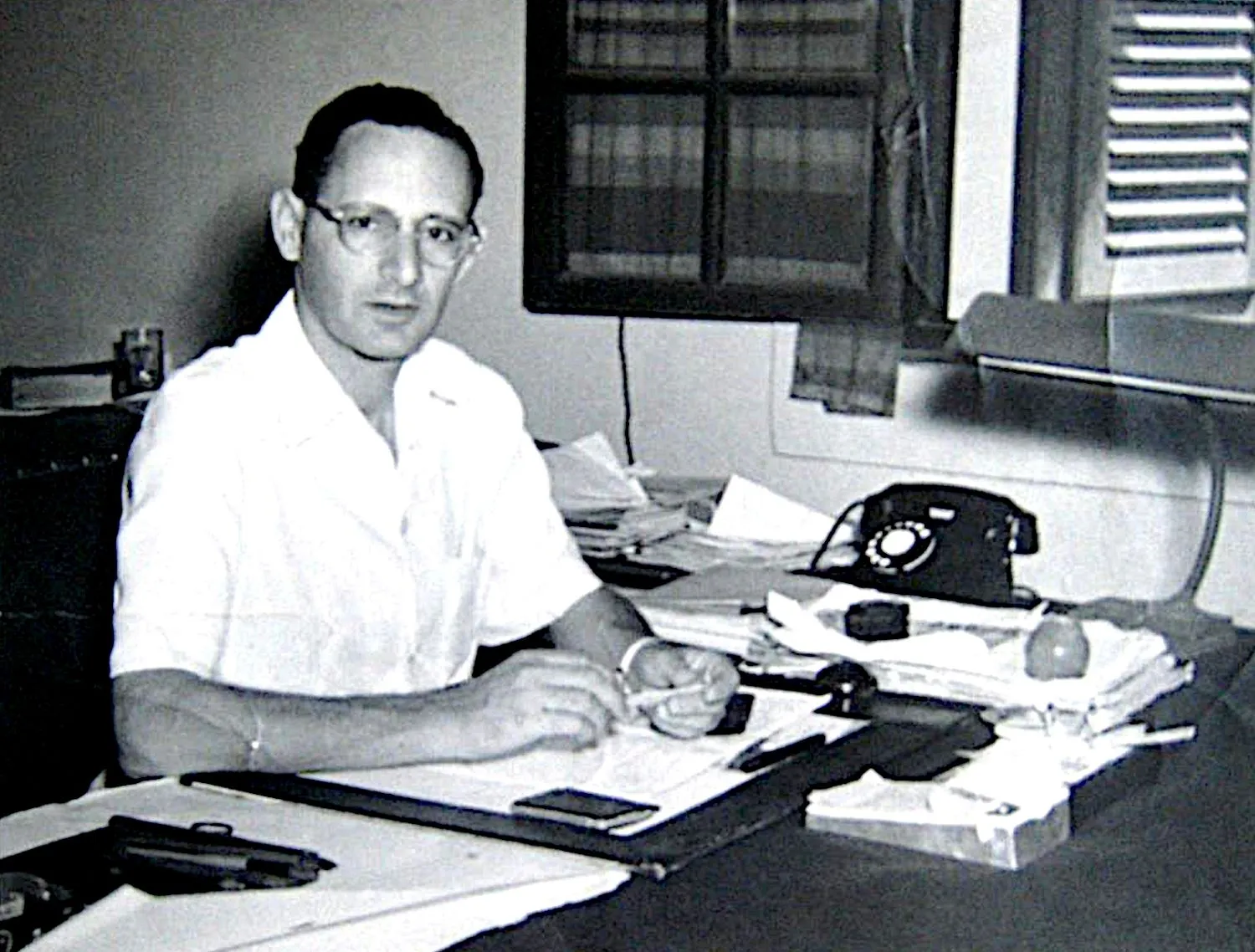
While building an entire township through refugee labor cooperatives looked brilliant on paper, executing it on the ground was a colossal challenge. Enter Laxmi Chand Jain (1925–2010), a 24-year-old youth serving as deputy to Sudhir Ghosh. He helped forge a formidable network of refugee labor cooperatives from the ground up in Faridabad.
Tempered as an underground courier for freedom fighter Sucheta Kripalani during the 1942 Quit India Movement, Jain’s path to refugee relief began with an unexpected command. In September 1947, as a fresh master’s student at Delhi University, he received an urgent summons from his mentor, “Go to Kingsway Camp at once and take charge.” When Jain protested, “But Didi, I’ve just enrolled for my M.A.,” Kripalani cut him off, “Your studies are finished. Go.”
Brought to Faridabad by Kamaladevi Chattopadhyay under the Indian Cooperative Union (ICU), Jain became the operational motor on the ground. Moving tent to tent alongside Ghosh, he patiently convinced traumatized refugees to trade passive government doles for self-reliant labor. His leadership completely dismantled the commercial contractor model. At its peak, this self-reliant framework mobilized over 4,000 refugee men and women in democratic teams of 10 to 15, embarking on a collective mission where everyone built homes for everyone else.
When outside commercial cartels attempted to exploit the project, Jain, Ghosh, and Chief Engineer M.J. Bhatt helped the refugees seize control of their own supply chains. Refugees fired kilns inside camp limits to produce hundreds of thousands of bricks daily. Reskilled themselves to establish woodwork units to fabricate doors and window frames, while refugee squads quarried and manually crushed stone to pave over 32 kilometers (20 miles) of township roads.
Under full transparency and direct oversight by future homeowners, this self-governing workforce eliminated contractor markups, waste, and corruption—literally raising a modern industrial city from the dust. It may be mentioned that LC Jain later in life went on to become a member of the Planning Commission and won the prestigious Ramon Magasasy Award.
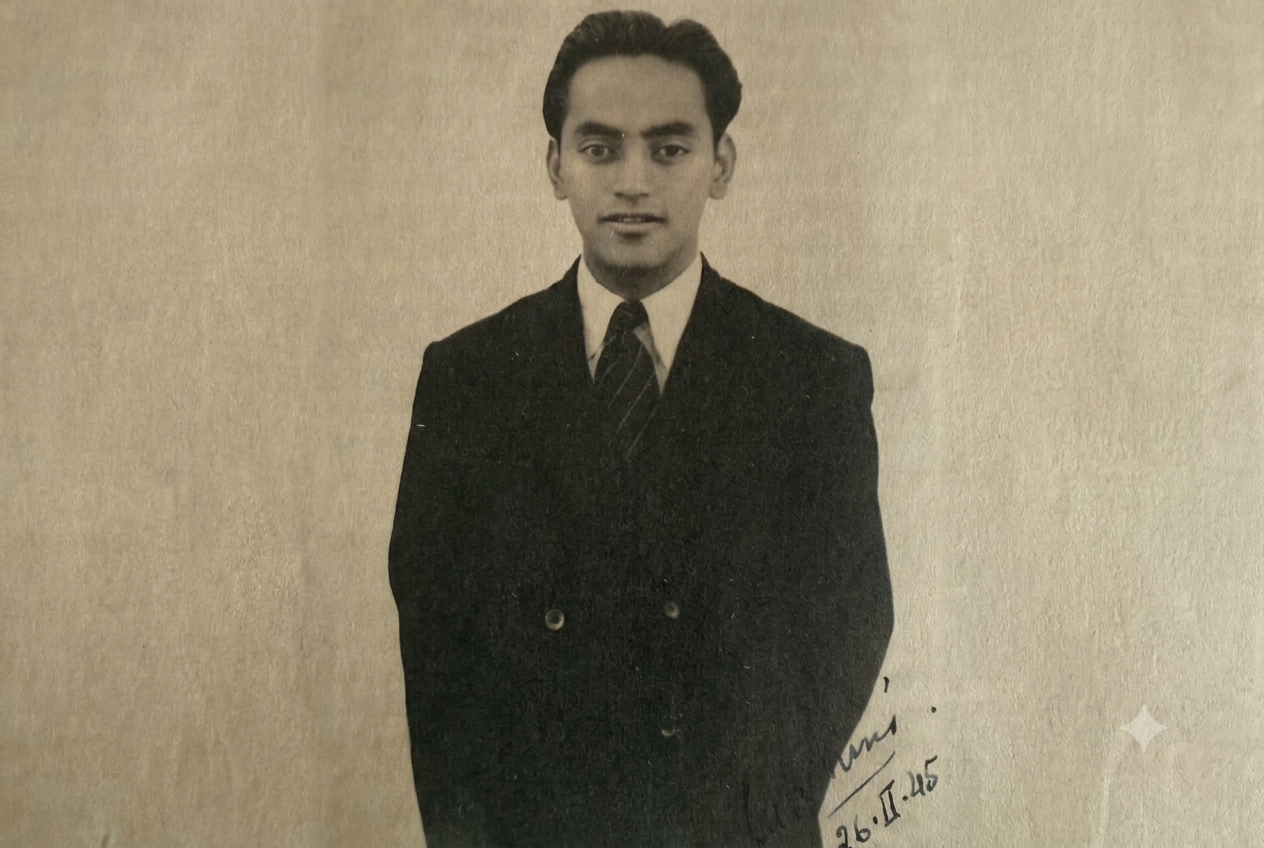
L.C. Jain pictured during his early days with the Indian Cooperative Union. He later served on India’s Planning Commission and received the prestigious Ramon Magsaysay Award for his lifelong crusade against grassroots poverty. [Photo: Museum of Material Memory]
Pillar 7: Beyond Bricks—Forging a Permanent Employment Engine
The Board knew a crucial truth: a town cannot live on construction forever. As the last scaffolding came down and the buildings stood complete, the construction work would inevitably taper off, leaving thousands without a livelihood once again. To prevent a second crisis, Faridabad executed one of post-independence India’s most brilliant economic pivots. Ghosh, Jain and the ICU set sights on laying the foundations of a permanent employment engine through cooperative enterprise.
The initial steps were modest. Long rows of women gathered in sunlit courtyards to spin charkhas, turning raw cotton into yarn to feed the newly established power looms. Meanwhile, small-scale cooperative units sprang up for button making, hosiery, and metalwork. These units were owned by the workers themselves, who retained both the dignity of labour and the profits.
Cooperative diesel engine manufacturing unit—an audacious experiment that almost worked: In a stunning breakthrough for the fledgling township, the Faridabad workshop, built to train displaced refugee youth, reverse engineered a German Deutz diesel engine, copying every part with precision
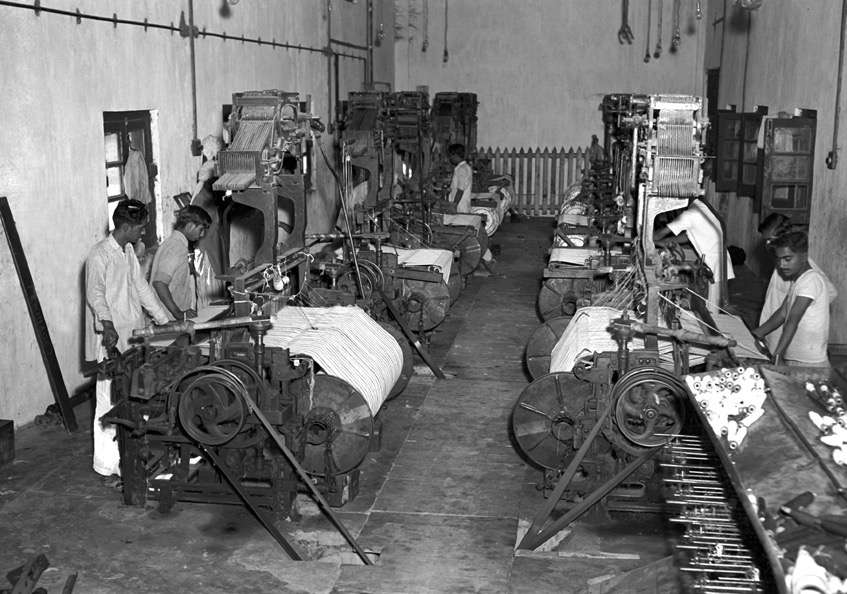
Workers operating power looms at a cooperative cloth-manufacturing facility in Faridabad, 1951. [Photo Heritage Lab]
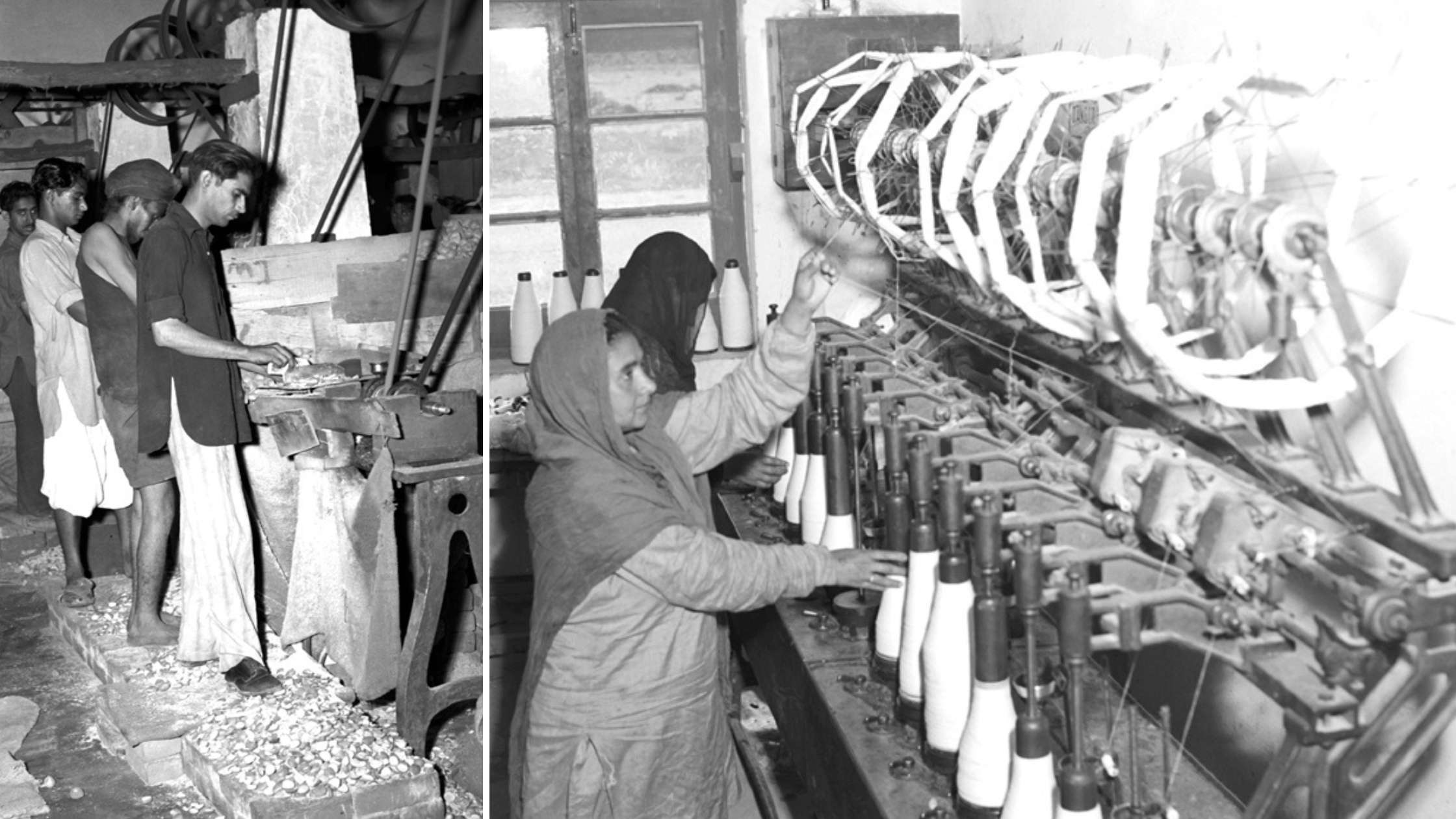
Left Panel: Refugee men undergoing technical workshop training and manufacturing small machine parts. Right Panel: Refugee women operating yarn-winding and hosiery spinning equipment in newly established cooperatives (photographed around November 1951). [Photo Heritage Lab]
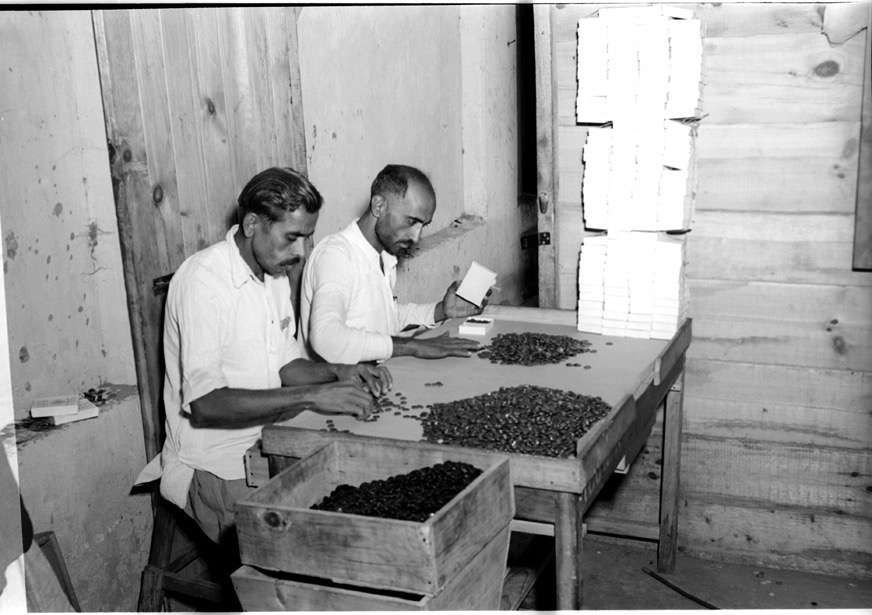
Workers hand-sorting finished buttons at a newly established cooperative industrial enterprise in Faridabad (November 1951). [Photo Heritage Lab]
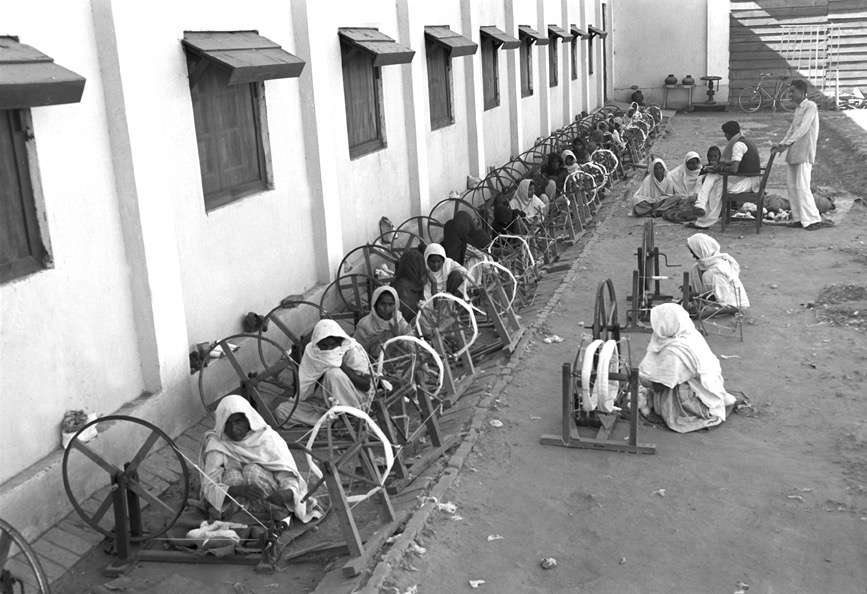
Women spinning yarn on charkhas (spinning wheels) at a cooperative yarn-manufacturing facility in Faridabad in 1951. [Photo Heritage Lab]
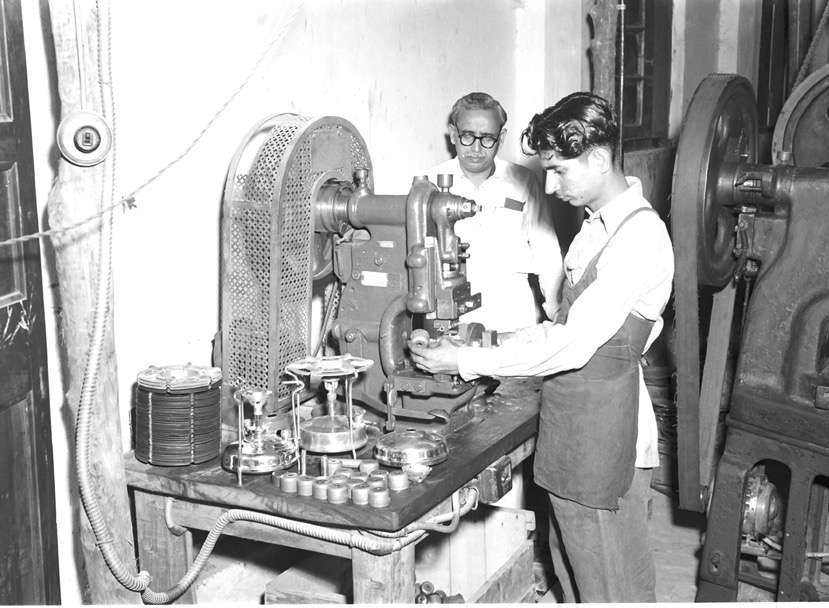
Stove Manufacturing Unit operating in Faridabad around November 1951. [Photo Division, Government of India]
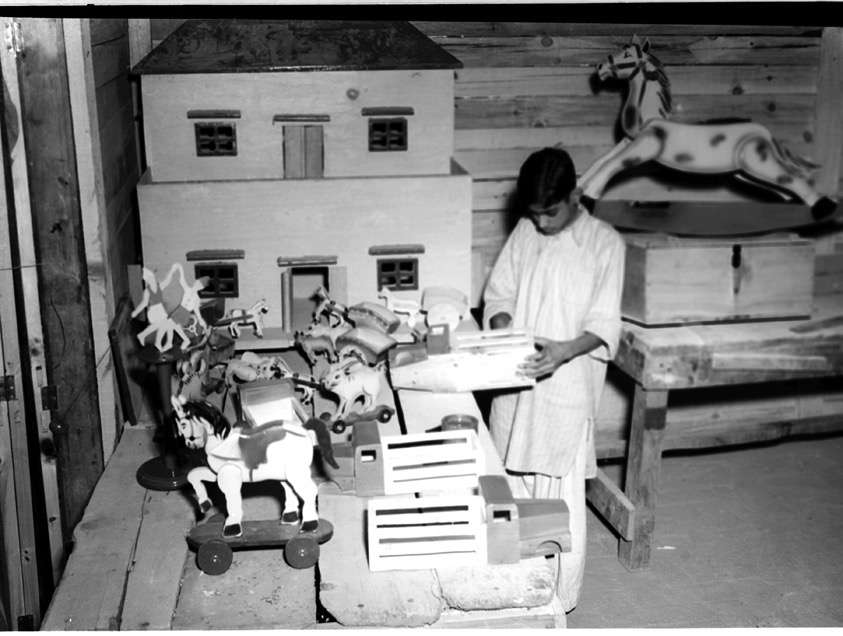
Toy Manufacturing Unit operating in the refugee settlement of Faridabad around November 1951. [Photo Heritage Lab]
Pillar 8: The Philosophy of Defiance
One thing that stood out in the Faridabad approach was a refusal to take no for an answer and a constant drive to challenge conventional wisdom. This was best exemplified by how Faridabad got its own power plant
When the board petitioned neighboring power networks for electricity, they were met with flat rejections. Both the Punjab Government and the Delhi administration refused to supply power to the fledgling refugee camp, maintaining that their own electricity grids were severely strained and could not spare a single kilowatt for a wilderness experiment. Faridabad was told to wait. But waiting meant stagnant workshops and a dead end for thousands of refugees trying to rebuild their lives. Sudhir Ghosh refused to let the dream die. He began hunting for an independent power source, leading him to an unlikely location: the docks of Calcutta Port.
Lying rusting in the sea spray of Calcutta Port were colossal iron crates—a massive 6,000 kW German thermal power plant, complete with two turbo-generators and La Mont high-pressure boilers. Surrendered by post-WWII Germany to the Allied powers as war reparations, the machinery had been shipped to India as part of post-war asset transfers. Because it was a non-standard, isolated European unit, without blueprints and manuals, state governments viewed it as an unusable white elephant. No authority wanted to bear the astronomical cost or technical nightmare of assembling it. The monolith sat abandoned, forgotten, and without takers, until Ghosh persuaded Prime Minister Jawaharlal Nehru to allocate the giant to Faridabad.
When the giant crates arrived at the campsite, the crisis deepened. The Central Public Works Department took one look at the iron mountain and declared it a total loss. Dismantled from a war-torn nation, the machinery came with zero replacement parts, while crucial technical manuals and blueprints were missing entirely. Worse, erecting multi-tonne boilers required heavy industrial cranes, equipment that young India simply did not possess. It appeared Sudhir Ghosh had stretched his gamble a bit too far.
Refusing to accept defeat, Ghosh, with the help of the Indian Military Mission in Berlin, tracked down Engineer Johannes Doll, a German technical expert who had intimately operated and maintained this exact plant when it was installed at the Blohm and Voss shipyard in Hamburg, Germany. Ghosh brought him directly to India. Expectations were that the foreign expert would demand luxury quarters in New Delhi. Instead, Doll fiercely refused, packing his gear and moving straight into a basic canvas tent on the dusty Faridabad site alongside the refugees.
Doll spoke strictly German—not a word of English. Yet, communicating through hand gestures, pencil sketches on wooden planks, and sheer technical force, he won the complete devotion of Chief Engineer Bhatt and the squads of Pathan refugees.
Where modern infrastructure failed, raw human ingenuity took over. Lacking factory spares, Doll trained and guided refugee men into tooling and lathe operations as they custom-forged missing linkages and components right in camp workshops. Sudhir Ghosh bought a large number of machine tools from German reparation, including lathes lying at Bombay docks, to set up a well-equipped technical workshop at Faridabad. He also got engineer Doll to bring an expert welder from Hamburg to Faridabad to weld the water tubes in the boilers. To raise the massive 50-ton boiler drums to 90 m above the ground, there were no cranes available. Doll engineered a synchronized network of jack screws and sleepers, lifting the colossal metal structures inch by painstaking inch into position.
In 1951, the impossible was achieved. Prime Minister Jawaharlal Nehru arrived at the site to officially inaugurate the power plant. As the German turbines roared to life, generating electricity from what had been dumped war debris, power surged across the township.
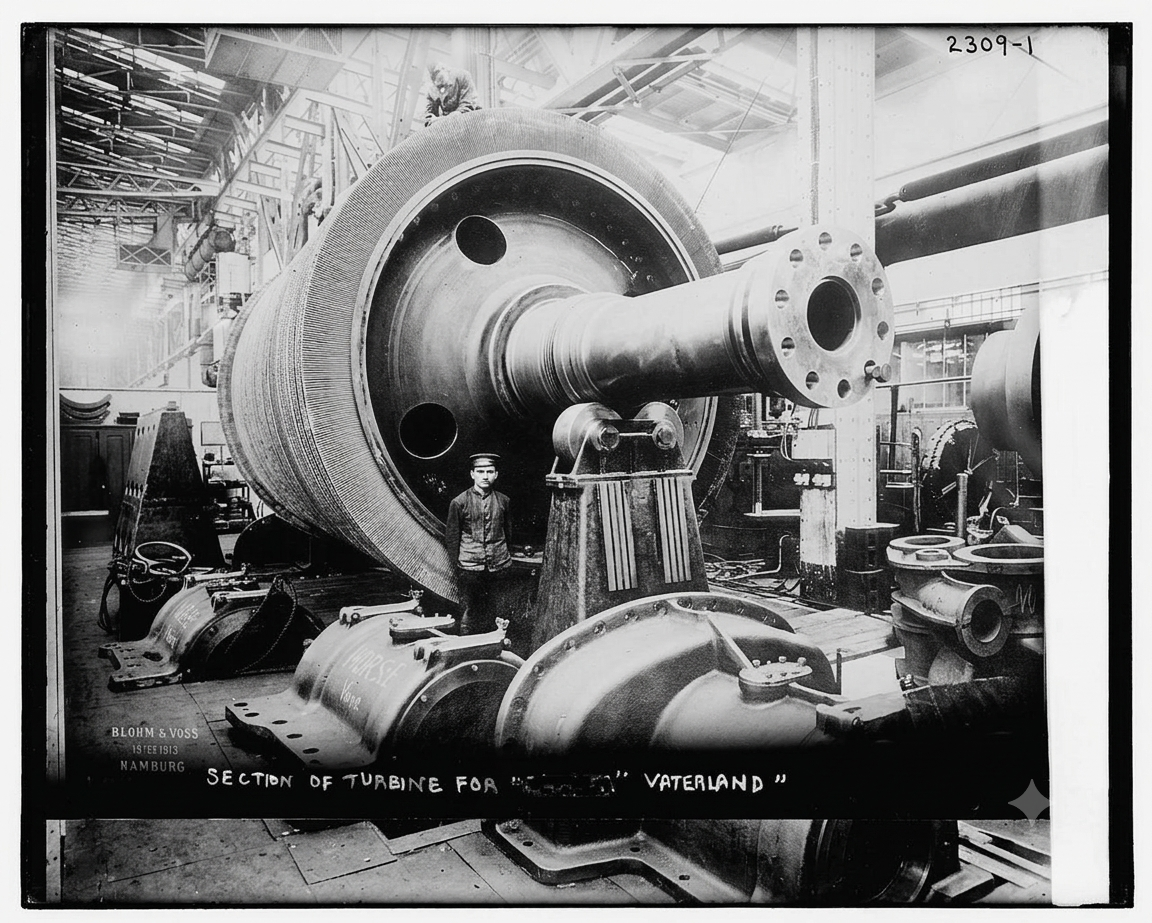
Heavy turbine engineering under construction at the Blohm & Voss shipyard in Hamburg, the same historic German manufacturing yard where Engineer Johannes Doll worked prior to bringing his technical expertise to Faridabad. [Photo: Library of Congress / Bain News Service]
While Doll and the refugee squads assembled the plant bolt by bolt, Chief Engineer Bhatt spearheaded the distribution network. Bhatt mobilized refugee teams to erect wooden poles, string miles of overhead lines across the scrubland, and installed transformer substations connecting the station directly to the township.
The most lasting impact of Herr Doll’s power plant was not the physical structure but the knowledge it left behind. The refugees who arrived with no formal background in heavy electrical engineering learned how to operate, maintain, and duplicate complex German machinery. This very training ground gave rise to Faridabad’s identity as a capital for small and medium-scale manufacturing (MSMEs), diesel generator mechanics, and machine tool fabrication shops that still dominate the city’s trade landscape today.
Pillar 9: Stopping at nothing attitude
This was the true spirit of Faridabad: a collective “stopping at nothing” attitude. When state bureaucracy shut doors, they built around it. When commercial cartels tried to starve them of bricks and stone, they dug their own clay and quarried their own hillsides. And when the capital refused to connect them to the power grid, they built the towers themselves and lit up Delhi.
Herr Doll’s power plant produced far more electricity than the fledgling township could immediately absorb, even as power-starved Delhi suffered acute energy shortages. The solution was obvious: Faridabad would sell its excess power back to the capital, generating vital revenue for new homes, roads, and schools.
Yet, Delhi’s authorities flatly refused to construct the transmission line. Realizing no help was coming, the Board took matters into its own hands: they would build the interstate power grid themselves.
The challenge of fabricating heavy steel transmission towers fell to Sagar Chand, Director of Faridabad’s Technical Institute—a facility originally set up to train refugee youth in technical trades. Lacking heavy industrial machinery, Chand turned his training workshops into a precision production line. Training displaced frontier youth on the spot into master fabricators, Chand’s team custom-built every tower from scratch, pulling off a 90-day miracle against a brutal clock.
Meanwhile, Chief Engineer M.J. Bhatt spearheaded the grueling installation across 8 kilometers of rugged, terrain stretching all the way from the refugee township to Okhla in Delhi. Bhatt marshaled refugee crews to pour concrete foundations and hoist heavy steel towers into the sky.
Step by step, the refugee teams marched forward until the high-voltage lines were secured. Soon, electricity generated by war-reparations machinery—assembled by refugees—was flowing directly into the nation’s capital, powering Delhi while securing the resources from the sale of electricity needed to finish building Faridabad.
PILLAR 10: Putting the Best Talent to Work
One of the overarching theme of the Faridabad experiment was a relentless talent strategy: finding the best minds available, stripping away bureaucratic protocol, and putting them directly to work on the ground. Nowhere was this philosophy better exemplified than in the creation of the township’s master plan.
As stated before, PWD Chief Engineer P.L. Varma’s initial 77-page blueprint hit a dead end due to its reliance on slow, conventional PWD channels and expensive private contractors. The Board did not sideline him. Instead, they doubled down on talent. It paired Varma’s ground-level engineering expertise with Otto Koenigsberger (1908–1999), a world-class German-Jewish architect and urban planner.
In 1933, Koenigsberger had been a rising star in German architecture, winning the prestigious Schinkel Prize for his design of the Berlin Olympic Stadium before Nazi racial laws forced him into exile. Finding sanctuary first in Egypt and then in India in 1939 with the support of his uncle, Nobel laureate Max Born (via Sir C.V. Raman). Koenigsberger served as Chief Architect of Mysore State before becoming India’s Federal Director of Housing. Having designed iconic structures for IISc Bangalore and early facilities for TIFR Mumbai, alongside master plans for Jamshedpur, Bhadravati, and Bhubaneswar, he brought top-tier authority to the table.
What followed was a rare meeting of minds: putting elite talent in service of human rehabilitation. An exiled architect designing for the exiled, backed by one of India’s finest public works engineers, produced the master plan for the Faridabad New Industrial Township (NIT), a blueprint built on radical empathy and technical excellence.
Rather than allowing chaotic urban sprawl, Koenigsberger split the city into five autonomous (NIT 1 to NIT 5), self-contained superblocks designed for 40,000 to 50,000 people. He allocated uniform plots arranged around central green squares, placing schools, dispensaries, and local bazaars within a 10-minute walk.
He mapped the heavy industrial zone entirely to the south, separating it from residential sectors with a wide linear green park that filtered away industrial chimney smoke while keeping factories within easy cycling distance.
To forge a unified community out of Partition’s trauma, plots were intentionally uniform, and different economic groups were deliberately interspersed within the same superblock, using shared public plazas to actively dissolve old social and caste hierarchies.
Above all, Koenigsberger mapped the physical layout as an active factory site; temporary brick kilns, wood workshops, and construction plazas were built directly into the urban grid, allowing the city to literally harvest, fabricate, and raise itself from the inside out.
Pillar 11: The Unspoken Sacrifice and the Rural Pact
Here lies the most profound, ironic truth of the Faridabad experiment: to resolve the tragic displacement of one community, the state engineered the quiet displacement of another.
Expanding the township beyond government-owned land required acquiring massive tracts of farmland from adjoining villages. Armed with powers of eminent domain, the state acquired private agricultural lands at minimal prices. Yet, there was no protest or dharna. Driven by deep empathy for Partition survivors and immense faith in leaders like Jawaharlal Nehru and Dr. Rajendra Prasad, local farmers accepted low compensation and surrendered their ancestral soil without resistance.
Before municipal infrastructure arrived, these local farmers opened their ancestral wells (kuas) and Persian wheels (rahats) unconditionally, helping refugee families draw water. They allowed the camp to scoop pliable silt and clay (gari/chicni matti) from the beds of village ponds (tobas) to seal tent bases against dust storms and bind raw bricks, permitted families to gather dry fallen wood for cooking fuel, and allowed refugee labor squads to extract raw clay straight from agricultural field edges to mold the township’s very first bricks.
In return, as documented by Sudhir Ghosh and L.C. Jain, the Faridabad Development Board instituted a policy of reciprocal welfare. Township infrastructure was intentionally extended to surrounding villages: the Board constructed a dedicated health center at Pali village to offer medical care while opening its schools, power supply, and technical training centers directly to the local agrarian population.
The unsung heroes of Faridabad’s birth were the families of the nine adjoining rural settlements who shared their resources so that 30,000 refugees could build a future:
The families of Saran watched their open pastures mapped into what became NIT-1, NIT-2, and the bustling crossroads of Payali Chowk. In Dabua, farmers yielded the rich earth that would hold NIT-3, central grain warehouses, and the heavy stone-crushing zones of Pahadi No. 3. Ancestral boundaries in Fatehpur Chandila and Badkhal were cleared to carve out NIT-4, while Ajronda and Daulatabad lost the agricultural tracts designated for NIT-5 and the key arterial routes around Neelam Flyover.
The most tragic loss of all was suffered by Manyharu—a village completely erased from the map and relocated miles away near Ballabgarh, where it was renamed Pratapgarh.
Today, the core landmarks of modern Faridabad—including Badshah Khan Hospital, Dussehra Ground, Nahar Singh Stadium, Rose Garden, and the city’s bustling sectors—stand directly on the ghost footprint of this erased agrarian world.
Pillar 12: Value of Dissent
Finally, Faridabad was not built by top-down decrees or rubber-stamping, but through creative friction among post-independence India’s brightest minds. Prime Minister Jawaharlal Nehru deliberately invited sharp dissenting voices to the Board—including Nai Talim pioneer Asha Devi Aryanayakam and economist J.C. Kumarappa—knowing that building a township required testing plans against uncompromising moral and economic critiques.
Kumarappa served as the board’s moral North Star. Educated at Columbia under E.R.A. Seligman (who also taught B.R. Ambedkar), he had abandoned corporate accounting in 1929 to lead Gandhi’s All India Village Industries Association from Wardha. Co-opted by Nehru despite sharp ideological rifts, Kumarappa resisted New Delhi’s push for heavy industrialization, advocating instead for decentralized, cottage-scale manufacturing to help bridge the immediate employment crisis at the camp.
This philosophy profoundly shaped operations on the ground. Key organizers Kamaladevi Chattopadhyay and L.C. Jain adopted Kumarappa’s landmark 1929 study, An Economic Survey of Matar Taluka, a definitive text in Gandhian economics, as their administrative bible to build worker-owned cooperatives. The text made such an impact on Jain that six decades later, on his first day at the Planning Commission in 1989, he reprinted 500 copies for his team—a quiet tribute to the enduring legacy of the Faridabad experiment
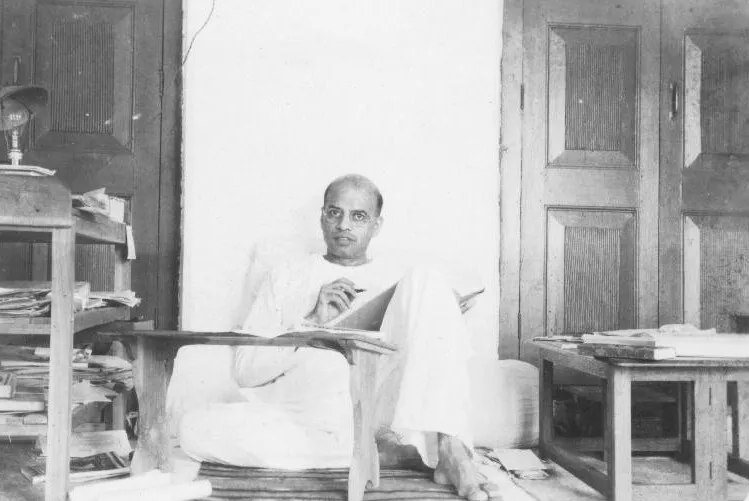
J.C. Kumarappa: [Photo: Sakthi, May 1947]
Sudhir Ghosh’s Departure: The Curtain Falls on the Experiment
On April 18, 1952, Sudhir Ghosh resigned from the Faridabad Development Board, exhausted by relentless political resistance.
Ghosh had managed the operations with a fiercely independent hand, frequently bypassing bureaucratic red tape to protect the cooperative autonomy of the refugees. In doing so, he made powerful enemies across New Delhi’s ministries. When administrative infighting reached a fever pitch and the political armour protecting the experiment began to crack, Ghosh resigned in protest, feeling betrayed by the very system he sought to humanize.
With his departure, the field teams working on site at Faridabad lost their operational freedom. Key autonomous arms—the Indian Cooperative Union (ICU), the engineering squads, the medical units, and the pioneer education networks—were stripped of executive protection.
In the wake of Ghosh’s exit, New Delhi dispatched senior civil servants—most notably S.G. Barve, ICS—to standardize operations. The Board shifted away from revolutionary experiments in refugee self-reliance, aligning itself with conventional, top-down urban administration.
Almost immediately, the Ministry of Finance launched a scathing retroactive audit of the Board’s records, targeting the pioneers with accusations of budgetary overruns and non-compliance with statutory civil service tender rules.
Seeing the vision of Faridabad under siege by auditors, Prime Minister Jawaharlal Nehru stepped in directly. Rebuking the critics, Nehru reminded Parliament and the bureaucracy that the primary duty of a democratic nation was the rehabilitation of human spirits and the restoration of dignity—not the rigid preservation of outdated colonial Public Works Department (PWD) manuals. The audits were cleared.
The Modern Metropolis and the Ghost of a Legacy
The radical experiments didn’t last forever. Eventually, the dust settled, the political shields cracked, and the frantic, beautiful chaos of the early years gave way to conventional administration. But the physical foundation laid by those 30,000 Pashtun refugees had already taken on a life of its own. Heavyweights like Eicher and Bata moved into the New Industrial Township grid, and Faridabad evolved into an unstoppable manufacturing powerhouse.
Yet today, a strange silence hangs over the city.
Walk down the busy streets, and you won’t find a single major avenue named after Kamaladevi Chattopadhyay or Sudhir Ghosh. There is no central park dedicated to M.J. Bhatt or L.C. Jain, and no plaque for Otto Koenigsberger. Step inside BK Hospital, and none of the wards recall Dr. Sushila Nayyar or Dr. Shanti Ghosh. Ask around, and you will find no school honoring Asha Devi Aryanayakam, nor will students at the city’s polytechnics know the names Sagar Chand or Johannes Doll.
And yet, they are everywhere.
They are there every time the evening breeze rustles through the Rose Garden, every time a cheer goes up at the Nahar Singh Stadium, and every time the lights flicker on across the NIT sectors. Modern Faridabad stands right on top of their invisible architecture. It rests on the ghost footprint of erased villages like Manyharu, on the generous opening of rural ancestral wells, on the hand-bolted transmission towers of Sagar Chand, and on the rusted German war turbines that a foreign engineer and refugee workmen brought back to life.
Faridabad is a thriving industrial city today. But more than that, it is a monument to a rare, fleeting moment when a traumatized nation chose dignity over charity, proving that when you give people tools instead of handouts, they can surprise you with their enterprise.
For modern-day planners, urban designers, and dreamers, Faridabad leaves behind a quiet, uncomfortable question: How long are we going to keep walking over the shoulders of the giants who made our homes, without ever stopping to look down and remember them?

